UP Hindu Wedding Traditions Explained
A detailed guide to UP Hindu wedding traditions, including common customs, symbolism, family meaning, and modern celebration style.
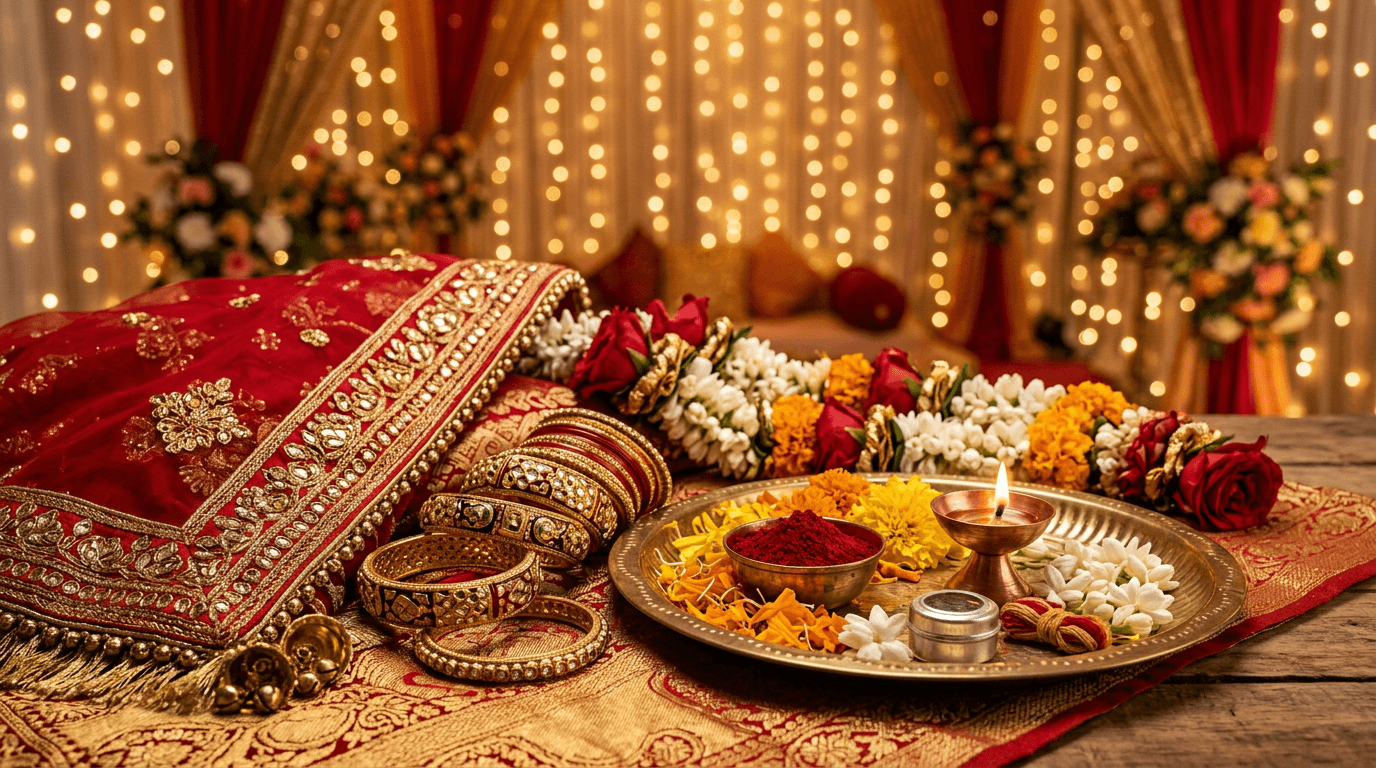
Hindu weddings in Uttar Pradesh are often known for their strong family character, layered rituals, emotional transitions, and deeply recognizable ceremonial moments. They may look familiar to people who know mainstream North Indian weddings, but within Uttar Pradesh there are still many local and family variations that shape the experience. In many households, the wedding is not only a social celebration but also a sacred journey through blessing, ritual commitment, family honor, and community participation. At the same time, not every UP wedding follows the exact same format. Regional culture, language, family traditions, and modern adaptation can all influence the sequence. This guide explains the common flow of UP Hindu wedding traditions, what major rituals usually mean, and how modern families in Uttar Pradesh celebrate weddings today.
On this page
- In simple words
- What makes UP weddings unique?
- Is every UP wedding the same?
- Common pre-wedding rituals
- What is Tilak?
- Role of Haldi and Mehendi
- Main wedding-day flow
- Varmala, Kanyadaan, Pheras, Sindoor
- What guests should know before attending
- How modern families celebrate
- How to explain rituals to guests
- Invitation wording angle
- Final thoughts
In simple words
A UP Hindu wedding is a North Indian Hindu wedding style known for strong family rituals, visible ceremonial customs, baraat-led celebration, sacred mandap ceremony, and emotionally important post-wedding moments like vidaai and griha pravesh. Many weddings commonly include rituals such as Tilak, Haldi, Varmala, Kanyadaan, Saat Pheras, Sindoor Daan, and Vidaai. However, the exact sequence and details can vary by family and region within Uttar Pradesh.
What makes UP weddings unique?
UP weddings are often distinct because they combine sacred marriage rites with large-scale family involvement and deeply emotional social customs. They are usually not only about the couple, but about both families, relatives, and community identity.
Common characteristics include
- Strong pre-wedding family rituals.
- Formal respect-oriented customs such as Tilak.
- Lively baraat and groom’s arrival.
- Emotionally important kanyadaan and vidaai moments.
- Sacred fire-based wedding ceremony.
- Deep role of family elders and relatives.
- Songs, teasing, and household customs in many homes.
For many guests, a UP wedding feels culturally familiar yet emotionally intense and strongly family-centered.
Is every UP wedding the same?
No. This must be explained clearly.
Hindu weddings in Uttar Pradesh may vary by
- Family tradition.
- Region such as Purvanchal, Awadh, Braj, or western UP.
- Household religious practice.
- Local language-cultural customs.
- How many pre-wedding rituals are retained.
- Whether the family follows a simpler or larger wedding format.
So while there are common North Indian wedding patterns across the state, it is not accurate to present all UP weddings as one universal script.
Common pre-wedding rituals in many UP weddings
Different families may structure these differently, but many Hindu weddings in UP commonly include some combination of these pre-wedding customs:
Tilak
- A formal and important pre-wedding ritual of respect, blessing, and alliance recognition.
Haldi
- A turmeric-based preparation ritual for the bride and groom.
Mehendi
- Henna ceremony for the bride and often for other women in the family.
Family pujas and household rituals
- These may vary by region and family, but often play an important role before the wedding.
Gift exchange and ceremonial visits
- Common in many families and help mark the transition toward the wedding day.
These rituals help move the wedding from family agreement into public and sacred celebration.
What is Tilak and why is it important?
Tilak is one of the most important and visible pre-wedding rituals in many UP Hindu weddings. It is often associated with formally honoring the groom and acknowledging the marriage alliance between the two families.
This ritual is commonly linked to
- Respect.
- Acceptance.
- Blessing.
- Ceremonial recognition of the alliance.
- Strengthening family ties.
In many homes, Tilak carries strong emotional and social importance because it marks that the relationship has moved into a public and formal stage.
What is the role of Haldi and Mehendi?
Haldi and Mehendi are two of the most familiar pre-wedding rituals in many UP weddings.
Haldi
- Turmeric-based preparation ritual associated with blessing, purification, and joyful family participation.
Mehendi
- Ceremony centered around henna, celebration, and bridal preparation, often with songs and gathering.
In many families, these rituals are remembered not only for their symbolism, but for the household joy and shared emotional participation they create.
Main wedding-day flow in many UP weddings
The exact order may vary, but many UP Hindu weddings commonly include:
Commonly seen stages (hosts may reorder)
- Baraat arrival.
- Groom’s welcome.
- Varmala / Jaimala.
- Mandap ceremony.
- Kanyadaan.
- Sacred fire rituals.
- Saat Pheras.
- Sindoor Daan.
- Blessings from elders.
- Vidaai.
- Griha Pravesh.
The wedding-day experience usually combines spectacle, sacredness, and strong emotional transition.
What are Varmala, Kanyadaan, Saat Pheras, and Sindoor Daan?
These are among the most important ritual moments in many UP weddings.
Varmala
- Bride and groom exchange garlands, symbolizing public acceptance of each other.
Kanyadaan
- Bride’s family formally gives her in marriage through sacred ritual and blessing.
Saat Pheras
- Seven sacred rounds around fire signifying vows and commitment.
Sindoor Daan
- A visible and emotionally significant marital symbol in many North Indian Hindu weddings.
Together, these rituals form the sacred and ceremonial center of the marriage.
What guests should know before attending
If this is your first UP wedding, expect a ceremony flow where symbolic moments and family participation matter as much as celebration. Some rituals may look quick, but they usually carry deep meaning for both families.
Quick guest notes
- Arrive before the key ceremony window, especially when muhurtham or fixed ritual timing matters.
- Dress in traditional or formal attire unless the host has shared a different style note.
- Follow ushers or close family cues during priest-led rituals instead of moving around frequently.
- Some customs may be unfamiliar to first-time guests, so a short ritual guide from the hosts is useful.
- Ask hosts in advance if there are separate timings for family-only rituals and open guest participation.
Clear communication about sequence, venue timing, and ritual context helps guests enjoy a UP wedding respectfully without confusion.
How modern UP families celebrate today
Modern families in Uttar Pradesh often preserve the key symbolic rituals while simplifying the broader wedding schedule.
Today’s weddings may
- Shorten smaller customs.
- Combine events for convenience.
- Use banquet or destination-style venues.
- Add modern receptions or cocktail formats.
- Use digital invitations and event pages.
- Explain rituals for younger or out-of-state guests.
- Preserve Tilak, Varmala, Pheras, and Vidaai while simplifying logistics.
This allows the wedding to remain culturally recognizable while fitting modern schedules.
How to explain UP wedding rituals to guests
If guests are not familiar with these customs, short explanations can help.
Examples
- Tilak: formal pre-wedding blessing and alliance recognition.
- Haldi: turmeric-based pre-wedding blessing ritual.
- Varmala: exchange of garlands by the couple.
- Kanyadaan: sacred giving of the bride in marriage.
- Saat Pheras: seven sacred marriage vows around the fire.
- Vidaai: emotional farewell of the bride.
- Griha Pravesh: ceremonial welcome into her new home.
These notes can be included in digital invitation pages, event schedules, wedding websites, or ceremony notes.
Invitation wording angle for UP weddings
UP weddings often include multiple familiar-but-layered rituals, so communication should be clear and respectful.
A good invitation or event page may include
- Function name.
- Date and time.
- Venue.
- RSVP.
- Whether the event is family-only or guest-inclusive.
- Sequence of wedding functions.
- Short explanation of important rituals if useful.
Digital event pages are especially useful when the wedding has multiple events and guests need help understanding the schedule.
Final thoughts
UP Hindu weddings are memorable because they combine sacred ceremony, emotional family customs, visible ritual symbolism, and strong community participation in a distinctive way. Whether the wedding is highly traditional or more modern in structure, the heart of a UP wedding often remains the same: family blessing, sacred union, and a meaningful beginning to married life.
Helpful links
FAQs – UP Hindu Wedding Traditions Explained
Are all UP Hindu weddings the same?
No. Weddings vary by family, region, and local cultural traditions within Uttar Pradesh.
Is Tilak very important in UP weddings?
Yes. In many UP weddings, Tilak is one of the most important and visible pre-wedding rituals.
Are Saat Pheras and Sindoor Daan central to the ceremony?
In many UP Hindu weddings, yes. They are among the most important sacred and symbolic parts of the marriage.
Is Vidaai always emotional in UP weddings?
Vidaai is one of the most emotionally significant parts of many North Indian weddings, including those in UP.
Can modern UP weddings be simplified?
Yes. Many families preserve the key sacred rituals while simplifying the larger event format.
Read next
Continue your learning journey with these related guides.
Wedding
Indian Wedding Ceremony Guide: Rituals, Meaning, Regional Variations, and Modern Relevance
A practical guide to Indian wedding rituals, regional traditions, family variations, and modern wedding planning.
4 min read
Wedding
Haldi Ceremony Guide: Meaning, Rituals, Regional Variations, and Benefits
A detailed guide to the Haldi ceremony, its meaning, origins, regional customs, and modern relevance in Indian weddings.
3 min read
Wedding
7 Pheras Meaning Guide: Significance, Symbolism, and Modern Relevance
A detailed guide to the meaning of the 7 Pheras, their symbolism in Hindu weddings, family variations, and modern significance.
4 min read

Digital invitations
How to Create a Digital Invite for Traditional Rituals
Step-by-step guide to creating ritual-friendly digital invites with RSVP, map, and WhatsApp sharing.
1 min read
Invitation wording
Wedding invitation wording ideas in English
Warm, clear English lines for cards and digital invites—hosts, dates, and RSVP ke saath.
1 min read
Wedding
Punjabi Wedding Traditions Explained
A detailed guide to Punjabi wedding traditions, including common rituals, family meaning, Sikh and Hindu differences, and modern celebration style.
7 min read
Wedding
Gujarati Wedding Rituals Explained
A detailed guide to Gujarati wedding traditions, including common rituals, family meaning, symbolic customs, and modern celebration style.
7 min read
Wedding
Bengali Wedding Customs in Simple Language
A detailed guide to Bengali wedding customs, including common rituals, family meaning, symbolism, and modern celebration style.
7 min read
Wedding
Bihari Wedding Traditions Explained
A detailed guide to Bihari wedding traditions, including common customs, symbolism, family meaning, and modern celebration style.
7 min read
Wedding
Garhwali Wedding Traditions Explained
A detailed guide to Garhwali wedding traditions, including common customs, symbolism, family meaning, and modern celebration style.
7 min read
Wedding
Haryanvi Wedding Traditions Explained
A detailed guide to Haryanvi wedding traditions, including common customs, symbolism, family meaning, and modern celebration style.
7 min read
Wedding
Sindhi Wedding Traditions Explained
A detailed guide to Sindhi wedding traditions, including common customs, symbolism, family meaning, and modern celebration style.
7 min read
Wedding
Assamese Wedding Traditions Explained
A detailed guide to Assamese wedding traditions, including common customs, symbolism, family meaning, and modern celebration style.
6 min read
Wedding
Kashmiri Hindu Wedding Traditions Explained
A detailed guide to Kashmiri Hindu wedding traditions, including common customs, symbolism, family meaning, and modern celebration style.
7 min read
Wedding
Kumaoni Wedding Traditions Explained
A detailed guide to Kumaoni wedding traditions, including common customs, symbolism, family meaning, and modern celebration style.
7 min read
Wedding
Marwari Wedding Traditions Explained
A detailed guide to Marwari wedding traditions, including common customs, symbolism, family meaning, and modern celebration style.
7 min read
Wedding
Himachali Wedding Traditions Explained
A detailed guide to Himachali wedding traditions, including common customs, symbolism, family meaning, and modern celebration style.
7 min read
Wedding
Odia Wedding Rituals Explained
A detailed guide to Odia wedding rituals, including common customs, symbolism, family meaning, and modern celebration style.
6 min read
Wedding
Tamil Wedding Traditions Explained
A detailed guide to Tamil wedding traditions, including common rituals, symbolism, family meaning, and modern celebration style.
7 min read
Wedding
Telugu Wedding Rituals Explained
A detailed guide to Telugu wedding rituals, including common customs, symbolism, family meaning, and modern celebration style.
7 min read
Wedding
Maharashtrian Wedding Ceremony Guide
A detailed guide to Maharashtrian wedding traditions, including common customs, symbolism, family meaning, and modern celebration style.
7 min read
Wedding
Rajasthani Wedding Rituals Explained
A detailed guide to Rajasthani wedding traditions, including common customs, symbolism, family meaning, and modern celebration style.
7 min read
Wedding
Malayali Wedding Customs Explained
A detailed guide to Malayali wedding customs, including common rituals, symbolism, family meaning, and modern celebration style.
7 min read
Wedding
Mehendi Ceremony Guide: Meaning, Traditions, Regional Variations, and Benefits
A detailed guide to the Mehendi ceremony, its meaning, origins, regional customs, and modern relevance in Indian weddings.
3 min read
Wedding
Sangeet Ceremony Guide: Meaning, Traditions, Regional Variations, and Benefits
A detailed guide to the Sangeet ceremony, its meaning, origins, regional customs, and modern relevance in Indian weddings.
3 min read
Invitation wording
Traditional Wedding Invitation Wording Examples
Classic Indian wedding invitation wording examples with formal, modern, and bilingual variants.
1 min read
On this page
- In simple words
- What makes UP weddings unique?
- Is every UP wedding the same?
- Common pre-wedding rituals
- What is Tilak?
- Role of Haldi and Mehendi
- Main wedding-day flow
- Varmala, Kanyadaan, Pheras, Sindoor
- What guests should know before attending
- How modern families celebrate
- How to explain rituals to guests
- Invitation wording angle
- Final thoughts