7 Pheras Meaning Guide: Significance, Symbolism, and Modern Relevance
A detailed guide to the meaning of the 7 Pheras, their symbolism in Hindu weddings, family variations, and modern significance.
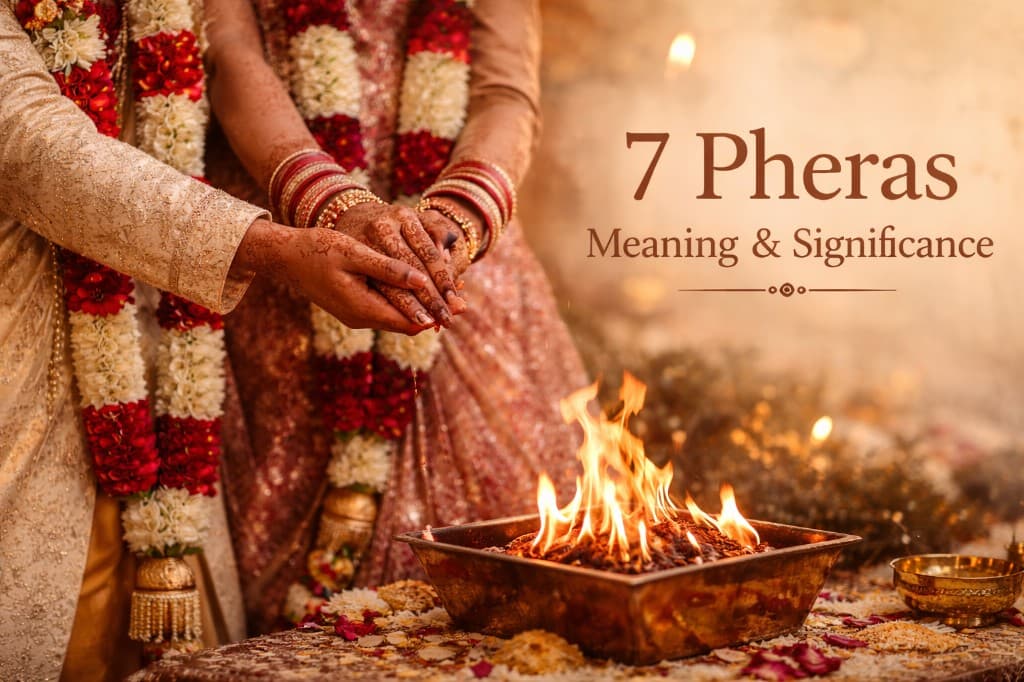
The 7 Pheras are one of the most recognized and meaningful parts of many Hindu wedding ceremonies. For many families, these rounds around the sacred fire symbolize commitment, shared responsibility, and the beginning of married life. At the same time, wording, order, and interpretation can vary by region, tradition, and family custom.
On this page
- What are the 7 Pheras?
- Why are they important?
- Religious and cultural background
- Meaning of each phera
- Are there always exactly 7?
- Regional and family variations
- Practical, emotional, and social value
- Scientific/psychological discussion
- Modern couple understanding
- How to explain to guests
- What guests should know before attending
- Final thoughts
What are the 7 Pheras?
The 7 Pheras are seven ceremonial rounds taken by the couple around the sacred fire in many Hindu wedding ceremonies. In many traditions, agni is treated as a sacred witness, and the rounds symbolize vows, partnership, responsibility, and a shared life.
Why are the 7 Pheras important?
- Sacred commitment before agni.
- Spiritual and social beginning of married life.
- Visible expression of mutual promises.
- Partnership built on shared responsibilities.
- Union in the presence of family and blessings.
Religiously and culturally, why do the 7 Pheras exist?
The 7 Pheras are rooted in Hindu marriage traditions and the broader understanding of marriage as a sacred samskara. In many traditional views, marriage is not only a social contract but a spiritually meaningful bond linked with shared dharma, duty, and partnership.
What does each of the 7 Pheras commonly symbolize?
- First: nourishment and stable life.
- Second: strength and mutual support.
- Third: prosperity and responsible living.
- Fourth: love, trust, and harmony.
- Fifth: family care and future generations (in traditions where emphasized).
- Sixth: health, peace, and balance.
- Seventh: lifelong friendship and companionship.
Do all Hindu weddings have exactly 7 Pheras?
Not always. Many Hindu weddings include seven rounds, but structure may vary by region, sampradaya, and family custom. In some traditions, saptapadi (seven steps) may be emphasized differently from the popular North Indian image of seven rounds.
Regional and family variations
North India
- Pheras are often the visible climax of the ceremony.
- Commonly explained as seven vows for married life.
South India
- Ceremony structure and emphasis may differ.
- Specific rites, mantras, or symbolic steps may be more prominent.
West India
- Gujarati, Marathi, and Rajasthani customs may vary in sequence and language.
- Family emphasis and explanation can differ.
East India
- Bengali and other eastern traditions may differ in sequence and explanation.
- Sacred commitment remains central even where details vary.
Practical, emotional, and social value
- Provides a solemn center to the ceremony.
- Helps couples reflect on partnership and responsibility.
- Turns abstract promises into visible ritual action.
- Allows families to witness commitment in structured form.
Are there scientific or psychological benefits?
The 7 Pheras should not be presented as a scientific or medical ritual. However, solemn public vows and symbolic action can have psychological and social value by strengthening commitment salience, memory of transition, and family-supported accountability.
Responsible framing
- ✓Avoid medical certainty claims.
- ✓Describe emotional, symbolic, and relational value.
- ✓Acknowledge variation in interpretation.
How modern couples understand the 7 Pheras
- Request simple-language explanations from priests or elders.
- Include translated summaries for guests.
- Blend tradition with values like equality, trust, and partnership.
- Keep pheras traditional while simplifying other wedding elements.
How to explain the 7 Pheras to guests
Seven sacred rounds around the fire that symbolize shared vows, lifelong partnership, and the beginning of married life.
Simple multilingual phrasing
- Sanskrit (common citation): Sakha Saptapada Bhava
- Transliteration: sakha saptapada bhava
- Simple English meaning: Let us walk as companions in this shared life.
- Simple Hindi meaning: हम इन सात कदमों के साथ जीवनसाथी और मित्र बनकर चलें।
Where to include this
- Wedding websites
- Event pages
- Family booklets
- Ceremony programs
- Digital invitations
What guests should know before attending
Phera moments are sacred and symbolic, so guest behavior during this segment strongly affects ceremony flow.
Quick guest notes
- Be seated before the phera sequence begins.
- Keep movement and phone activity minimal near the sacred fire.
- Ritual language may be unfamiliar, so hosts can share a short meaning note.
- Different families may follow different wording or order; variation is normal.
- Photography should stay coordinated so sacred moments are not interrupted.
This helps first-time guests experience the depth of pheras without confusion or disruption.
Final thoughts
The 7 Pheras remain meaningful in many Hindu weddings because they combine symbolism, sacred witness, family presence, and shared commitment. Even when interpretations vary, the core promise remains powerful: to walk through life together with trust, respect, and companionship.
Helpful links
FAQs – 7 Pheras Meaning Guide: Significance, Symbolism, and Modern Relevance
Are the 7 Pheras the most important part of every Hindu wedding?
In many Hindu weddings, pheras are among the most important moments, but exact structure and emphasis vary by tradition.
Do all regions interpret each phera in the same way?
No. Broad symbolism may be similar, but wording, sequence, and emphasis can vary.
Are 7 Pheras only cultural or also religious?
For many Hindu families, they are both religiously meaningful and culturally important.
Do the 7 Pheras have scientific benefits?
It is more accurate to describe spiritual, emotional, symbolic, and social significance rather than scientifically proven benefit.
Can we show one simple Sanskrit line to guests?
Yes, if framed carefully as a commonly cited line and not as the only universal wording used in every tradition.
Read next
Continue your learning journey with these related guides.

Wedding
Indian Wedding Ceremony Guide: Rituals, Meaning, Regional Variations, and Modern Relevance
A practical guide to Indian wedding rituals, regional traditions, family variations, and modern wedding planning.
4 min read

Wedding
Haldi Ceremony Guide: Meaning, Rituals, Regional Variations, and Benefits
A detailed guide to the Haldi ceremony, its meaning, origins, regional customs, and modern relevance in Indian weddings.
3 min read
Wedding
Mehendi Ceremony Guide: Meaning, Traditions, Regional Variations, and Benefits
A detailed guide to the Mehendi ceremony, its meaning, origins, regional customs, and modern relevance in Indian weddings.
3 min read
Wedding
Sangeet Ceremony Guide: Meaning, Traditions, Regional Variations, and Benefits
A detailed guide to the Sangeet ceremony, its meaning, origins, regional customs, and modern relevance in Indian weddings.
3 min read
Wedding
Roka Ceremony Guide: Meaning, Traditions, Family Significance, and Benefits
A detailed guide to the Roka ceremony, its meaning, family importance, regional customs, and modern relevance in Indian weddings.
4 min read

Invitation wording
Traditional Wedding Invitation Wording Examples
Classic Indian wedding invitation wording examples with formal, modern, and bilingual variants.
1 min read
On this page
- What are the 7 Pheras?
- Why are they important?
- Religious and cultural background
- Meaning of each phera
- Are there always exactly 7?
- Regional and family variations
- Practical, emotional, and social value
- Scientific/psychological discussion
- Modern couple understanding
- How to explain to guests
- What guests should know before attending
- Final thoughts