Indian Wedding Ceremony Guide: Rituals, Meaning, Regional Variations, and Modern Relevance
A practical guide to Indian wedding rituals, regional traditions, family variations, and modern wedding planning.
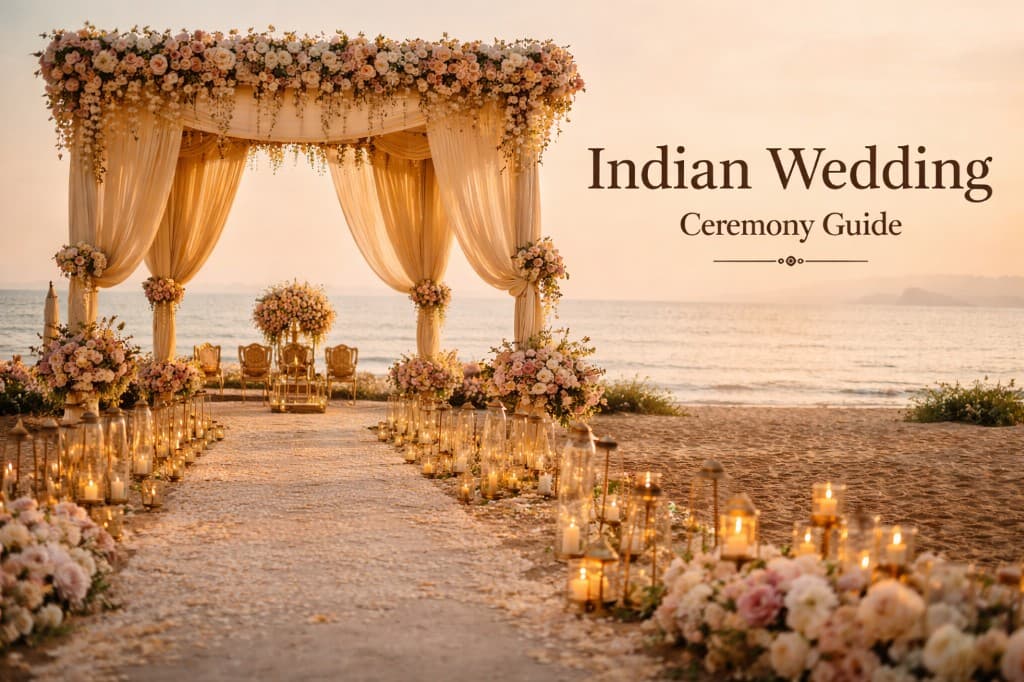
Indian weddings are not just about one ceremony or one day. For many families, a wedding is a series of rituals, blessings, celebrations, and shared memories that bring together relatives, traditions, and community. At the same time, there is no single Indian wedding format that applies everywhere.
On this page
- What is an Indian wedding ceremony?
- Why are wedding rituals important?
- Common events in a wedding journey
- Main wedding ceremony
- Regional variations across India
- Family, community, and religious differences
- How did these rituals begin?
- Scientific benefit discussion
- How weddings are changing
- Planning tips for families
- What guests should know before attending
- How to mention functions in invites
- Final thoughts
What is an Indian wedding ceremony?
An Indian wedding ceremony is a set of traditional, cultural, and family-centered events that mark the beginning of married life. Depending on region, religion, and family customs, the ceremony may include spiritual rituals, cultural symbols, family blessings, music, food, and social gatherings.
Why are wedding rituals important?
Wedding rituals often carry emotional, cultural, and spiritual meaning. They help families celebrate a major life transition with structure and shared participation. In many traditions, these rituals symbolize commitment, responsibility, and the joining of two families.
Common events in an Indian wedding journey
- Roka or engagement: formal acknowledgment of the match in many families.
- Mehendi: celebration with henna, music, and gathering.
- Haldi: pre-wedding ritual associated with blessings and joyful preparation.
- Sangeet: music and dance-led family celebration.
- Main wedding ceremony: the central ritual event.
- Vidaai: emotional farewell in traditions where observed.
- Reception: post-wedding celebration with guests.
What usually happens in the main wedding ceremony?
The main wedding ceremony depends on region and religion, but many Indian weddings include symbolic elements such as family blessings, ritual exchanges, sacred prayers, and formal commitments between the couple. In many Hindu weddings, rituals may include garland exchange, sacred fire, pheras, and symbols of marriage. Sikh, Muslim, Christian, and other communities follow different religious frameworks.
Regional variations across India
North India
- Often includes roka, mehendi, haldi, sangeet, wedding, and reception.
- Baraat, varmala, and pheras are common in many families.
South India
- Often more ceremony-centered and may begin earlier in the day.
- Auspicious timings, mandap or temple traditions, floral decor, and structured rituals are often important.
- Tamil, Telugu, Kannada, and Malayalam-speaking traditions can differ from each other.
West India
- Includes Gujarati, Marathi, Rajasthani and other traditions.
- Distinct customs, songs, dress styles, hospitality patterns, and family rituals may appear.
East India
- Bengali and other eastern traditions often have distinct ceremonial details.
- Dress customs, symbolic rituals, and family roles may vary significantly.
Family, community, and religious differences
- Hindu weddings often include sacred fire, mantras, and family blessings.
- Sikh weddings center on Anand Karaj.
- Muslim weddings usually revolve around nikah and related customs.
- Christian weddings may include church ceremonies, vows, rings, and local family traditions.
Even within the same religion, customs can vary widely by family and community.
How did these rituals begin?
The roots of Indian wedding rituals are layered. Some customs are connected to Vivaha Samskara traditions and Grihya-Sutra-linked ceremonial frameworks, while others evolved through regional culture and family practice over generations. Not every ritual has one fixed historical origin, and responsible writing should separate text-linked tradition from later social custom.
Are there scientific benefits to wedding rituals?
This topic should be handled carefully. Not every traditional wedding ritual has a proven scientific basis. Many rituals can still have practical, emotional, and social value such as helping families process life transitions, building social bonds, and giving structure to large family events.
How modern Indian weddings are changing
- Families simplify rituals and reduce event count.
- Intimate weddings are increasingly common.
- Many combine traditions from two regions or communities.
- Digital invitations and RSVP tools improve planning clarity.
- Hosts explain rituals for younger guests and cross-cultural attendees.
Tips for families planning a wedding
- ✓Respect tradition, but prioritize clarity and comfort.
- ✓Explain each function clearly to guests.
- ✓Mention date, time, venue, RSVP, and dress note where needed.
- ✓Use digital invites for multi-event weddings.
- ✓Keep communication simple across guest groups.
- ✓Balance family expectations with practical planning.
What guests should know before attending
Indian weddings can move between sacred ritual and social celebration quickly, so guest guidance improves experience.
Quick guest notes
- Arrive with buffer time for key ceremonies.
- Expect tradition-specific customs that may not be self-explanatory.
- Follow host or usher instructions during ritual segments.
- Dress and timing notes should be read carefully.
- Short ritual guides are helpful for first-time attendees.
Practical context helps guests stay respectful and engaged across diverse ceremony formats.
How to mention wedding functions in an invitation
If your wedding includes Mehendi, Haldi, Sangeet, Wedding, and Reception, the invitation should clearly separate each function and detail. This is especially useful for elders, outstation guests, and friends unfamiliar with the sequence.
Include in invitation
- Couple names
- Family/host names where needed
- Event schedule
- Venue details
- RSVP
- Map or directions
- Optional dress note
We invite you to celebrate our wedding with love, blessings, and togetherness across our Mehendi, Haldi, Wedding, and Reception ceremonies.
Final thoughts
An Indian wedding is not one fixed format. It is a living combination of ceremony, family values, cultural memory, region, and modern choice. The best approach is not to look for one correct format, but to understand what matters to a particular family and celebrate it meaningfully.
Helpful links
FAQs – Indian Wedding Ceremony Guide: Rituals, Meaning, Regional Variations, and Modern Relevance
Are all Indian weddings multi-day events?
No. Some are multi-day and elaborate, while others are simple and focused mainly on the main ceremony.
Do all Indian weddings have Haldi, Mehendi, and Sangeet?
No. These are common in many communities, but they are not universal.
Are regional differences important in Indian weddings?
Yes. Regional differences are very important, and wedding formats can differ significantly across India.
Can modern couples simplify rituals?
Yes. Many families adapt rituals to match time, budget, comfort, and modern preferences while preserving meaning.
Should every ritual be explained as directly scriptural?
No. Some elements are text-linked, while others are community customs. It is best to explain this distinction clearly.
Read next
Continue your learning journey with these related guides.
Wedding
Haldi Ceremony Guide: Meaning, Rituals, Regional Variations, and Benefits
A detailed guide to the Haldi ceremony, its meaning, origins, regional customs, and modern relevance in Indian weddings.
3 min read
Wedding
Mehendi Ceremony Guide: Meaning, Traditions, Regional Variations, and Benefits
A detailed guide to the Mehendi ceremony, its meaning, origins, regional customs, and modern relevance in Indian weddings.
3 min read
Wedding
Sangeet Ceremony Guide: Meaning, Traditions, Regional Variations, and Benefits
A detailed guide to the Sangeet ceremony, its meaning, origins, regional customs, and modern relevance in Indian weddings.
3 min read
Wedding
Roka Ceremony Guide: Meaning, Traditions, Family Significance, and Benefits
A detailed guide to the Roka ceremony, its meaning, family importance, regional customs, and modern relevance in Indian weddings.
4 min read
Wedding
7 Pheras Meaning Guide: Significance, Symbolism, and Modern Relevance
A detailed guide to the meaning of the 7 Pheras, their symbolism in Hindu weddings, family variations, and modern significance.
4 min read

Invitation wording
Traditional Wedding Invitation Wording Examples
Classic Indian wedding invitation wording examples with formal, modern, and bilingual variants.
1 min read
RSVP
RSVP Wording for Indian Invitations
RSVP lines that are polite but clear, with examples for wedding and family function invitations.
1 min read
On this page
- What is an Indian wedding ceremony?
- Why are wedding rituals important?
- Common events in a wedding journey
- Main wedding ceremony
- Regional variations across India
- Family, community, and religious differences
- How did these rituals begin?
- Scientific benefit discussion
- How weddings are changing
- Planning tips for families
- What guests should know before attending
- How to mention functions in invites
- Final thoughts