Haldi Ceremony Guide: Meaning, Rituals, Regional Variations, and Benefits
A detailed guide to the Haldi ceremony, its meaning, origins, regional customs, and modern relevance in Indian weddings.
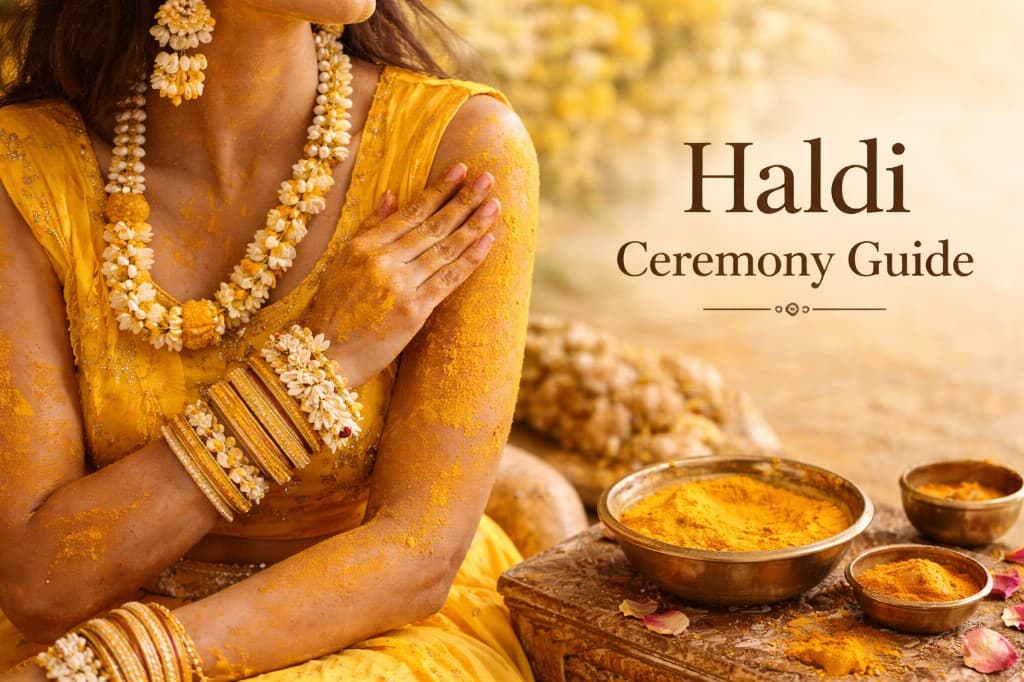
The Haldi ceremony is one of the most loved and recognizable pre-wedding rituals in many Indian weddings. It is joyful, intimate, and deeply connected to family participation. It is not only about fun or photos; for many families it carries symbolic, cultural, and in some traditions religious meaning.
On this page
- What is the Haldi ceremony?
- Why is Haldi important?
- Religious and cultural origins
- What usually happens
- Regional variations across India
- Practical and social benefits
- Scientific benefit discussion
- Modern Haldi celebrations
- Planning tips
- What guests should know before attending
- How to mention Haldi in invite
- Final thoughts
What is the Haldi ceremony?
The Haldi ceremony is a pre-wedding ritual in which turmeric paste, often mixed with ingredients such as sandalwood, rosewater, curd, or oil depending on family custom, is applied to the bride, groom, or both. It is commonly held one or two days before the wedding.
Why is the Haldi ceremony important?
- Marks preparation for an auspicious new beginning.
- Carries blessings from loved ones.
- Creates emotional bonding before the main ceremony.
- Acts as a joyful pause before formal wedding rituals.
- Symbolizes transition into married life.
Religiously and culturally, why did Haldi begin?
Haldi is best understood as a mix of traditional symbolism, cultural continuity, and regional custom rather than one universal source. In many tradition-led households, turmeric is associated with auspiciousness, purification, and positive beginnings. In some families the ceremony is more ritual-led; in others it is mainly celebratory. This is best framed as tradition-linked practice, not a single text-mandated rule for all weddings.
What usually happens in a Haldi ceremony?
- Gather close family and friends.
- Seat the bride or groom in a decorated area.
- Prepare turmeric-based paste.
- Apply paste with blessings, songs, laughter, and photos.
- Host light snacks or meal; in modern events, include decor and photography coverage.
Regional variations across India
North India
- Often lively and highly visible with yellow decor, floral jewelry, music, and playful participation.
- Some families keep it intimate; others scale it as a major pre-wedding event.
South India
- Turmeric-related practices may appear in different ritual forms depending on community.
- In many families, ritual preparation is embedded within traditional sequence rather than a separate modern Haldi event.
West India
- Gujarati, Marathi, and Rajasthani traditions may have distinct names, songs, and presentation styles.
- Family blessing remains central while ceremonial details vary.
East India
- Pre-wedding turmeric customs exist in several eastern traditions with their own symbolism and sequence.
- Bengali and other regional communities may follow distinct styles.
Practical and social benefits
- Brings families together before the main ceremony.
- Creates a relaxed and emotionally warm environment.
- Helps couples feel supported.
- Makes wedding journey more personal and participatory.
- Creates memorable shared moments.
Are there scientific benefits to Haldi?
This should be explained carefully. Turmeric has longstanding traditional association with cleansing and skin preparation in many households, and many families believe it supports freshness before the wedding. However, a Haldi ceremony is not a medical treatment, and reactions vary by skin sensitivity and ingredients.
Responsible way to present this
- ✓Acknowledge traditional wellness associations.
- ✓Avoid universal medical claims.
- ✓Recommend patch testing and skin-safe ingredients for sensitive skin.
How modern families celebrate Haldi today
- Coordinated yellow outfits and floral decor.
- Music playlists or dhol.
- Photographer/videographer coverage.
- Custom seating and backdrop.
- Mix of traditional and modern elements.
- Separate invite flow for Haldi when needed.
Tips for planning a Haldi function
- ✓Keep ceremony timing clear.
- ✓Use dress suggestions only if useful.
- ✓Use skin-safe paste ingredients.
- ✓Do not force participation.
- ✓Plan comfort, cleanup, and photography.
- ✓Include elders in an easy, respectful way.
- ✓Clarify intimate vs open gathering if both families attend.
What guests should know before attending
Haldi is often joyful and playful, but guest comfort and consent still matter throughout the function.
Quick guest notes
- Wear outfits that can handle turmeric stains.
- Do not apply Haldi to someone without consent, especially elders or formal guests.
- Expect a mix of ritual blessing and lighthearted family interaction.
- If participation is limited to close family, hosts should mention it clearly.
- A short timing note helps first-time guests join at the right moment.
This keeps the function fun while respecting family boundaries and ritual intention.
How to mention Haldi in an invitation
- Ceremony name
- Date and time
- Venue
- Host/couple details
- RSVP
- Optional dress theme if relevant
Join us for a joyful Haldi ceremony as we celebrate love, laughter, blessings, and the start of our wedding festivities.
Final thoughts
Haldi beautifully combines symbolism, family warmth, and celebration. For some families it is deeply traditional; for others it is a modern pre-wedding gathering. In both, it remains meaningful because it brings people together at the start of a new chapter.
Helpful links
FAQs – Haldi Ceremony Guide: Meaning, Rituals, Regional Variations, and Benefits
Is the Haldi ceremony compulsory in every Indian wedding?
No. Haldi is common in many Indian weddings, but it is not universal.
Is Haldi a religious ritual or a cultural function?
It can be both, depending on family tradition and community context.
Can Haldi be done jointly for bride and groom?
Yes. Some families keep it separate; others combine it.
Does Haldi have proven scientific benefits?
Turmeric has traditional wellness associations, but Haldi should not be presented as a universally proven medical treatment.
Read next
Continue your learning journey with these related guides.
Wedding
Indian Wedding Ceremony Guide: Rituals, Meaning, Regional Variations, and Modern Relevance
A practical guide to Indian wedding rituals, regional traditions, family variations, and modern wedding planning.
4 min read
Wedding
Mehendi Ceremony Guide: Meaning, Traditions, Regional Variations, and Benefits
A detailed guide to the Mehendi ceremony, its meaning, origins, regional customs, and modern relevance in Indian weddings.
3 min read
Wedding
Sangeet Ceremony Guide: Meaning, Traditions, Regional Variations, and Benefits
A detailed guide to the Sangeet ceremony, its meaning, origins, regional customs, and modern relevance in Indian weddings.
3 min read
Wedding
Roka Ceremony Guide: Meaning, Traditions, Family Significance, and Benefits
A detailed guide to the Roka ceremony, its meaning, family importance, regional customs, and modern relevance in Indian weddings.
4 min read
Wedding
7 Pheras Meaning Guide: Significance, Symbolism, and Modern Relevance
A detailed guide to the meaning of the 7 Pheras, their symbolism in Hindu weddings, family variations, and modern significance.
4 min read

Invitation wording
Haldi Invitation Message Ideas
Formal, casual, and short WhatsApp Haldi message templates you can adapt quickly.
1 min read
On this page
- What is the Haldi ceremony?
- Why is Haldi important?
- Religious and cultural origins
- What usually happens
- Regional variations across India
- Practical and social benefits
- Scientific benefit discussion
- Modern Haldi celebrations
- Planning tips
- What guests should know before attending
- How to mention Haldi in invite
- Final thoughts