Birthday Celebration in Hindu and Western Culture: Traditions, Meaning, Candles, and Modern Practice
A detailed guide to birthday celebration in Hindu and Western culture, including janma tithi, diya vs candles, traditional observance, and modern family practice.
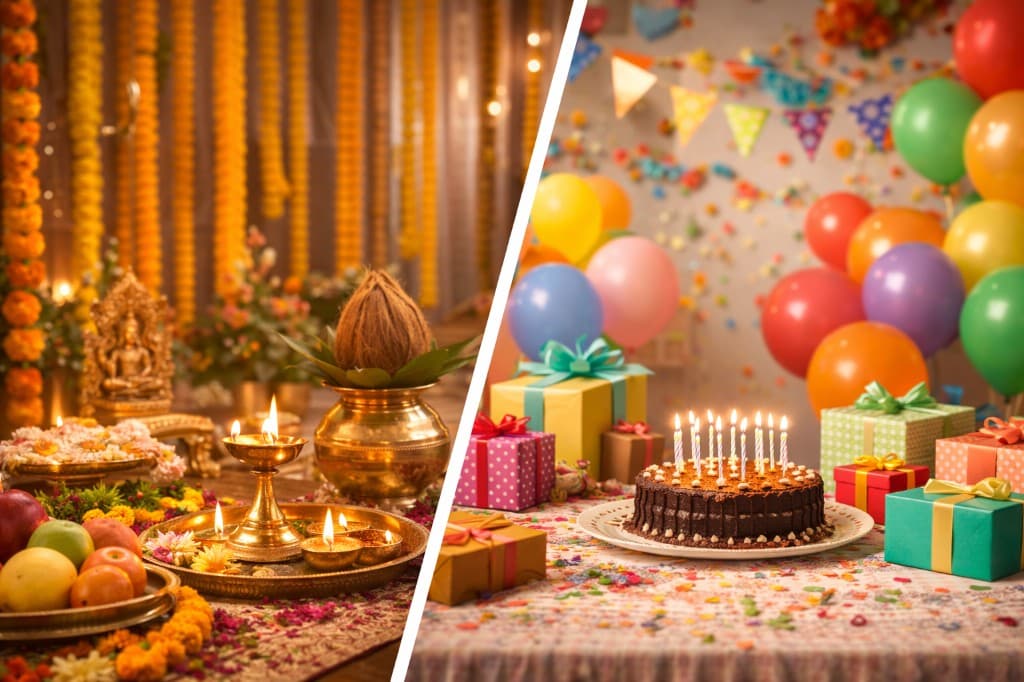
Birthdays are celebrated all over the world, but the meaning behind the celebration can look very different depending on culture, family tradition, and religious outlook. In many Western contexts, birthdays are usually associated with cake, candles, gifts, singing, and a social party. In many Hindu families, however, a birthday may also be seen as a spiritual and family-centered occasion connected with gratitude, blessings, longevity, prayer, and auspicious observance. Today, many Indian families combine both styles. They may celebrate socially on the English calendar date and also observe the day traditionally according to janma tithi or janma nakshatra. This guide explains the difference, the symbolism, the traditional Hindu approach, the question of candles and diya, and how modern families can celebrate birthdays in a way that feels both meaningful and joyful.
Quick answer
In Western culture, birthdays are commonly celebrated with cake, candles, singing, and making a wish on the calendar date of birth. In many Hindu families, birthday observance is traditionally more connected with janma tithi or janma nakshatra, blessings from elders, puja, temple visit, diya lighting, prayer, and sometimes longevity rituals such as Ayushya Homa in specific traditions. Modern Hindu families often combine both styles. If someone wants a birthday celebration that is more aligned with Hindu ritual symbolism, lighting a diya and seeking blessings is usually more culturally aligned than centering the act of blowing out a flame.
How birthdays are commonly celebrated in Western culture
In common Western-style birthday celebration, the focus is usually on personal milestone joy and social gathering. It is not usually tied to lunar dates, nakshatra, puja, or ritual observance.
Typical elements
- Celebrating on the calendar birth date
- Cake cutting
- Lighting birthday candles
- Singing a birthday song
- Making a wish
- Blowing out candles
- Gifts and social gathering
- Fun and personal celebration
How birthdays are traditionally understood in Hindu culture
In many Hindu families, a birthday can be understood not only as a personal milestone but also as a sacred opportunity to express gratitude for life, seek blessings for health and longevity, and remember one’s relationship with family, elders, and dharma. The emphasis is often less on entertainment alone and more on the themes below. In this sense, a Hindu birthday observance may feel more like a combination of family ritual, prayer, and blessing rather than only a party.
Common emphases
- Blessing
- Prayer
- Gratitude
- Spiritual wellbeing
- Respect for parents and elders
- Auspicious beginnings for the coming year
Janma tithi and janma nakshatra: why they matter
In many Hindu traditions, a person’s traditional birthday may be observed according to janma tithi or janma nakshatra rather than only the Gregorian calendar date.
Definitions
- Janma tithi: the lunar day associated with one’s birth.
- Janma nakshatra: the birth star or lunar mansion under which the person was born.
Many traditional Hindu families consider tithi- or nakshatra-based observance more aligned with Hindu calendrical and ritual practice. This does not mean the English date celebration is invalid. It simply means that in a traditional Hindu framework, the lunar marker may carry more ritual significance for many families.
How birthdays were and are traditionally celebrated in many Hindu families
Traditional Hindu birthday observance can vary by region, sampradaya, and family, but common practices often reflect gratitude, light, and blessings.
Practices many families include
- Waking early; a clean or intentionally mindful start to the day
- Offering namaskar to parents and elders; receiving blessings
- Puja to kuladevata, ishta devata, or family deities where relevant
- Lighting a diya
- Temple visit
- Offering fruits, flowers, or prasad
- Charity, donation, or feeding others
- Prayer for health, wellbeing, and longevity
- In some traditions, Ayushya Homa or Ayush Homam for blessings related to long life and protection
These practices are not identical in every Hindu household, but they reflect the general traditional spirit of the day.
Dharmic-aligned birthday practices (careful framing)
Rather than claiming one rigid “Vedic birthday rulebook,” it is more accurate to say that Hindu-tradition-aligned birthday observance often emphasizes the following. These are better described as dharmic or tradition-aligned practices than as a single universally codified rule that all Hindus must follow.
Common themes in tradition-aligned observance
- Janma tithi or janma nakshatra awareness, linked to the lunar calendar as well as the English birth date
- Respect for parents and elders; seeking blessings as an expression of gratitude and humility
- Puja and prayer for health, right action, and wellbeing in the coming year
- Lighting of a lamp or diya, associated in many families with auspicious beginnings
- Daan or service—giving, feeding, or sharing as a meaningful way to mark the day
- In some communities, Ayushya-oriented rituals associated with longevity and blessings
Should candles be lit or blown out?
This is one of the most common modern questions. If the celebration follows a Western birthday style, lighting and blowing out candles is a common social custom. But if the goal is to celebrate in a way that is more aligned with Hindu ritual symbolism, many families may prefer lighting a diya, beginning with prayer, taking blessings, and not making the extinguishing of a flame the main symbolic action.
In Hindu ritual culture, light is usually associated with auspiciousness, prayer, knowledge, and sacred presence. For that reason, lighting a lamp feels more naturally aligned with Hindu symbolism for many families than blowing out a flame. This should not be framed as a universal ban on candles; it is better framed as a symbolic preference when the celebration is meant to center Hindu-tradition symbolism.
Diya vs candle: symbolic difference
Western-style birthday symbolism (common)
- Candle, wish, blowing out the flame
- Party-centered celebration
Hindu-tradition-centered symbolism (common)
- Diya or lamp
- Prayer and blessing
- Light as auspicious presence
- Gratitude and sacred beginning
This is why many families choose to light a diya first, take blessings, and then optionally cut a cake later.
Is cake cutting against Hindu tradition?
Not necessarily. Cake cutting is a modern social practice, not a core Hindu ritual. Many Hindu families include cake without feeling that they are rejecting tradition. The more relevant question is what is the main symbolic center of the day. If the celebration begins with blessings, prayer, diya, gratitude, and temple visit or puja, then cake can become an additional social element rather than the defining ritual of the day.
What many modern Hindu families do today
A common blended approach
- Observe janma tithi or janma nakshatra in a spiritual or family way
- Celebrate socially on the English birth date
- Begin the day with diya and blessings
- Visit a temple or do a short puja
- Offer prasad
- Then celebrate with cake, family meal, or gathering
This blended approach works well for many families because it preserves tradition without rejecting contemporary celebration.
A practical Hindu-tradition-friendly birthday flow
Morning
- Bath and clean start
- Namaskar to parents and elders
- Diya lighting
- Short prayer or puja
- Temple visit if possible
During the day
- Donation, feeding, or an act of goodwill
- Family blessings
- Simple sattvic meal or prasad
Later
- Birthday gathering
- Cake if desired
- Photos, gifts, and celebration
This creates a balance between sacredness and celebration.
How to explain this to children or younger family members
In Western birthdays, candles and cake are a fun way to celebrate. In Hindu tradition, a birthday can also be a day to thank the divine, take blessings from elders, and begin the new year of life with light, prayer, and good wishes.
This framing helps younger family members see tradition as about meaning, not only rules.
How to write a birthday invitation in a Hindu-tradition-friendly way
If the birthday includes puja, tithi observance, or a blessings ceremony, the invitation should make that clear. Include celebration details, puja timing, venue, meal timing, RSVP, and whether the event is traditional, social, or both.
With gratitude and blessings, we invite you to join us in celebrating [Name]’s birthday with a family prayer, blessings, and a joyful gathering.
Final thoughts
A birthday can be celebrated in many beautiful ways. In Western culture, it is often a joyful personal celebration centered around cake, candles, and gathering. In Hindu tradition, it may also be understood as a sacred opportunity for gratitude, blessings, prayer, and a spiritually aligned beginning to the next year of life. For many modern families, the most meaningful path is not choosing one side rigidly, but understanding the symbolism behind both and celebrating in a way that feels respectful, joyful, and true to their values.
Helpful links
FAQs – Birthday Celebration in Hindu and Western Culture: Traditions, Meaning, Candles, and Modern Practice
Do Hindus celebrate birthdays by English date or tithi?
Many modern families celebrate socially on the English date, while traditionally oriented observance may happen on janma tithi or janma nakshatra.
What is janma tithi?
Janma tithi is the lunar day associated with one’s birth and is considered important in many Hindu calendrical traditions.
Is blowing out candles against Hindu tradition?
It is better described as a Western birthday custom rather than a Hindu ritual act. Many Hindu families who want a more tradition-aligned celebration prefer diya lighting and blessings instead.
Is lighting a diya better than candles in a Hindu birthday celebration?
For a Hindu-tradition-centered observance, lighting a diya is generally more symbolically aligned with prayer, auspiciousness, and sacred beginnings.
What is Ayushya Homa?
In some traditions, Ayushya Homa or Ayush Homam is a ritual associated with prayers for longevity, wellbeing, and protection.
Can we celebrate both traditionally and in a modern way?
Yes. Many families do both by starting with puja and blessings and later having cake and a social gathering.
Read next
Continue your learning journey with these related guides.
Housewarming
Griha Pravesh Ritual Guide: Meaning, Traditions, Regional Variations, and Modern Relevance
A complete and practical guide to Griha Pravesh rituals, meanings, regional customs, and modern family planning choices.
1 min read
Shagun & traditions
Why Is Shagun Given in Odd Amounts? Meaning of 101, 501, 1100 and More
A practical and culturally aware guide to why shagun is often given in odd amounts like 101, 501, and 1100, and what these amounts commonly suggest in Indian family functions.
7 min read

Digital invitations
How to Create a Digital Invite for Traditional Rituals
Step-by-step guide to creating ritual-friendly digital invites with RSVP, map, and WhatsApp sharing.
1 min read

Invitation wording
Griha Pravesh Invitation Message Ideas
Housewarming and Griha Pravesh invitation wording examples in a respectful and practical tone.
1 min read
Planning
What details should every invitation include
Hosts, event name, date/time, location, dress code, RSVP—ek checklist jo miss nahi honi chahiye.
1 min read